

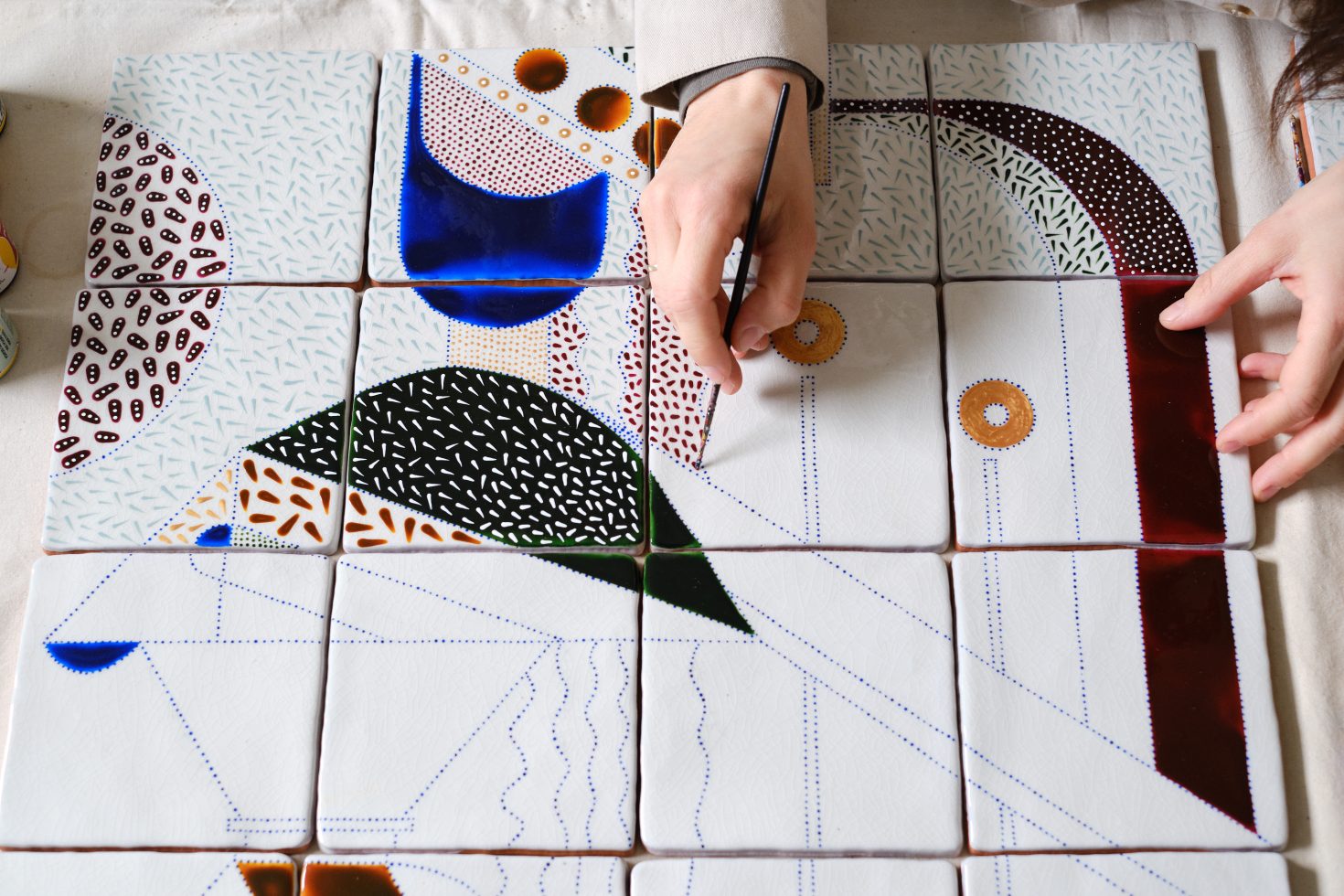
Myrsini Alexandridi is a visual artist whose practice magnetizes the gaze with its unique harmony and beauty; It centers on the art of painting on ceramic tiles and bridges the boundaries between fine art and craft, transforming a traditionally decorative medium into a vibrant field of personal expression.
Myrsini Alexandridi talked to Ex_posure.
Myrsini you are an architect and an artist currently living in Sweeden; But where are you coming from, literary and metaphorically?
I grew up in Athens, in a neighborhood called Egaleo, a landscape of small houses, narrow streets, and modest parks where children could still walk to school and play freely in the squares. It was a place of intimacy and rhythm, where daily life unfolded within walking distance. From Friday to Sunday, though, my scenery changed. I was living with my grandparents to the city center, in an apartment on Patision Street — a place dense with stories and sounds, directly across from the School of Architecture. I often think now that perhaps, even then, architecture was silently entering my world through that window.
During holidays, we always escaped the city. We went to Skopelos, my great-grandmother’s and grandmother’s island, and to Volos, where my parents were born. I remember crying each time we left Skopelos, feeling as if the sea hadn’t yet told me all its secrets. I’ve never missed a summer there. It’s the place that shaped my sense of belonging, of color, of texture. The roots of the olive trees I used to play around as a child are my own roots.
Literally, I come from two very different places — Athens, chaotic, urban, layered, full of contradictions and energy, and Skopelos, luminous, authentic, suspended between the blue of the sea and the green of the pine trees. Metaphorically, I come from the space in between those two worlds,from the dialogue between movement and stillness, structure and intuition, noise and silence. I come from the desire to connect these contrasts, to find beauty in their coexistence.
Your art practice is mainly focused on a unique material, tiles. How did this started? What other materials do you use and why?
It all began quite unexpectedly, a random encounter with a box of white tiles in a thrift shop in Amsterdam. I remember being instantly drawn to them, their simplicity, their silent promise. I bought them without really knowing why, just with the impulse to paint on them. Until then, I had always worked on paper – drawing, painting, sketching — but there was something about the tiles that fascinated me. Perhaps it was their ceramic nature, that tactile quality that connects to the earth, or perhaps it was the glossy white surface — so still, so receptive — waiting to hold a story, a gesture, a trace.
I think what appealed to me most was this combination of fragility and permanence. A tile can break so easily, yet it can also last for centuries, carrying color and form across time. That duality resonates deeply with me — the idea that something delicate can also be enduring.
I still use paper a lot in my process; it remains my most immediate medium, the space where I think and translate ideas before they find their material form. My sketches are usually in black and white — I like to strip things down to their essence — but I often return to watercolors when I need to reconnect with softness, transparency, and emotion. Each medium offers a different rhythm, a different way of listening to what the work wants to become.
The compositions of tiles you create, the motifs you use are mesmerizing; what are the sources of your ispiration?
Every time I’m asked about inspiration, I find myself giving a different answer, and I think that says a lot about how inspiration actually works. It’s never fixed, it evolves, it transforms as I do. My sources of creativity are in constant dialogue with my experiences, my emotions, and the ways I perceive the world at a given moment. What inspires me today might shift tomorrow, and I’ve learned to embrace that movement rather than resist it.
Still, there are certain archetypes — recurring forms and ideas — that seem to follow me, quietly shaping my visual language. These archetypal inspirations are deeply connected to Greek identity, and by extension, to my own. Through my work, I often try to revisit, question, and even reinvent what “Greekness” means to me, beyond clichés or nostalgia. It’s a process of excavation and reconstruction, bringing fragments of memory, mythology, architecture, and landscape into a contemporary context.
When I paint a new composition, I see it as a conversation between the past and the present, between inherited symbols and personal emotion. The motifs might look decorative at first glance, but behind them there is always an ongoing search for balance, belonging, and meaning.
Architecture and art; how do you balance trough them?
I dare say that, for me, it was always about art. Architecture came as an extension of that — a more structured, tangible way to approach space, light, and emotion. I studied architecture for almost ten years, including my postgraduate studies, and I truly loved it. It offered me a framework through which I could explore my artistic instincts, challenge my boundaries, and understand the dialogue between imagination and reality. But even during that time, I always approached architecture from a more romantic, poetic point of view, as a form of art rather than a discipline of pure function.
I worked as an architect for about a decade, and those years were invaluable. Yet, deep down, I always sensed that it wasn’t entirely my path. For the past couple of years, I’ve focused entirely on my art. Looking back, I often describe the relationship between the two as a balance between freedom and necessity — art was the freedom, architecture the structure that kept me grounded.
Now, when I collaborate on architectural projects, I do so from a completely different perspective, as an artist, not a practitioner. I enjoy this position immensely because it allows me to see architecture as an integral part of my creative thinking, rather than as a separate profession. In many ways, architecture still lives within my work, in the way I compose space on a tile, in how I think about proportion, rhythm, and texture. It’s embedded in my way of seeing, painting, and even performing.